Fact: I will never not cry watching Little Women. Whether it’s the treacly sweet 1949 version starring June Allyson and a young Elizabeth Taylor, or Gillian Armstrong’s near-perfect 1994 adaptation with a fierce Winona Ryder, tears will be shed for the trials, triumphs, losses and joys of the March family of Concord, Connecticut.
And so it is with the latest screen iteration of the American classic. Written and directed by Greta Gerwig (Lady Bird), this version of Little Women gives the tear ducts a good workout even as it jumbles the now-familiar storyline to provide a fresh take on the travails of Miss Josephine March; Saoirse Ronan a more than admirable addition to those – Allyson, Ryder, and Katharine Hepburn in 1933 – who have previously portrayed the headstrong, second eldest March daughter.
Some may bristle at this tampering with the timeline, so ingrained are the story beats of Louisa May Alcott’s beloved novel, but with Armstrong’s version still so strong in many people’s minds (has it really been 25 years?), Gerwig was wise to mix things up.
That may mean events, like its heroine, unfold at a breathless pace, and some elements – Jo’s friendship-cum-romance with German émigré Professor Bhaer (Louis Garrel) – may not have quite the same emotional impact, but all in all, this Little Women is both faithful and fresh. Emma Watson (Meg), Eliza Scanlen (Beth), and especially Florence Pugh (Amy) make their mark as Jo’s siblings, as does Timothee Chalamet as Laurie, the March sisters’ neighbour, proxy brother, attempted suitor and eventual husband/brother-in-law. Laura Dern makes for a suitable Marmee, though not as memorable as Susan Sarandon’s take in the ’94 version; much more successful is Meryl Streep with her exasperated eye-rolls as the rich but withered Aunt March.
2019 has not been a great year, even less so in the last month; Little Women is a timely salve for the heart and soul. And, as it opens in Australia on New Year’s Day, the perfect way to begin a new year and new decade. Yes, there will be tears but mostly happy ones.

Through a seamless blend of actual audio recordings and in-the-moment footage, Apollo 11 captures history as it happens - that history being the 1969 moon landing.
Fifty years later, those images are, for the most part, as pristine as though they were shot on modern-day digital, while the conversations between mission control in Houston and the three astronauts - Neil Armstrong, Buzz Aldrin and Michael Collins - as they orbit the Earth and shoot for the moon, are enlightening and riveting. Indeed, the outcome is never in doubt but there's a level of suspense in Apollo 11 that makes its 93-minute run time just fly by.
Refreshingly void of voice over narration and talking head interviews, director Todd Douglas Miller, who also edited this documentary, lets events play out and speak for themselves.
A perfect companion piece to Damien Chazelle's most excellent First Man (2018), a biopic of sorts of Armstrong's life leading up to and culminating in his historic first steps on the lunar surface, Apollo 11 is an impressive way to mark the 50th anniversary of this most historic event.

The dark-souled cousin to Hirokazu Kore-eda's Shoplifters (2018), Bong Joon-ho's Cannes-winning Parasite takes the underclass family out of their impoverished hovel and into the home of the one-percenters; rubbing them up against each other to comic and discomfiting effect.
In what begins as a light-hearted con by the Kim family, who, one by one, inveigle themselves into the architecturally stylish yet austere home of the well-to-do Parks, Parasite gradually develops – or descends – into an excoriating satire of the divide between the haves and the have-nots in modern-day South Korea.
Of course, Bong's tale is universal: the gap between the rich and the poor continues apace in most late-stage capitalist economies, and Australian audiences cannot fail to see the unflattering similarities between both societies. (Jordan Peele served up a similarly tart humble pie to his fellow Americans with US earlier this year.)
Where Parasite goes beyond its initial set-up, however, is best left to be discovered by the audience. Needless to say, no one gets off – or out – unscathed.

What would a world without the music of The Beatles look like? Well, there'd be no Oasis for starters, and for some reason there wouldn't be any Coke or Harry Potter either.
That's the state of the world in director Danny Boyle and screenwriter Richard Curtis's Yesterday, in which struggling musician Jack Malik (Himesh Patel) awakens from a cycling accident and realises that no one – not even Google – has heard of John, Paul, George and Ringo. What to do? Cash in, of course.
Super-stardom beckons when fame – and Ed Sheeran – literally come knocking at the door of this nobody who is now, apparently, the greatest musical wordsmith of all-time. But guilt, impostor syndrome and matters of the heart – Jack can't decide if he's in love with his long-time best friend and manager, Ellie (Lily James) – keep Jack from grasping fame ("the poisoned chalice" as his new American manager, Debra Hammer (MVP Kate McKinnon), describes it) with both hands.
Not a jukebox musical of the Fab Four's greatest hits, nor a full-on romcom – indeed the romantic subplot is the film's least interesting and least successful element – Yesterday is everything a truly great Beatles song isn't: safe, bland, and forgettable.

It's been 12 years since a Spike Lee joint released in Australian cinemas. Whether that is because of the inconsistency of Lee's output or local distributors' seeming reluctance to release 'black' films is a debate for another time.
That last cinema release, however, was the entertaining mainstream thriller Inside Man, starring Denzel Washington, Clive Owen and Jodie Foster. Lee's latest film, BlacKkKlansman, arguably his most mainstream and entertaining since that 2006 release, stars Denzel's son, John David Washington.
He plays Ron Stallworth in this 'fo' real' true story of how a black police officer in 1970s Colorado Springs managed to successfully infiltrate the Ku Klux Klan. No, not by using white face (this isn't a Wayans brothers comedy, though there's much humour to leaven the incendiary drama) but by means of a proxy: Jewish detective Flip Zimmerman (Adam Driver).
Having established, via telephone, a rapport with the local leader of the Organisation (that's what the KKK prefer to call themselves, for PR purposes), Officer Stallworth needs Zimmerman to act as him to gain access to the group's inner sanctum. "You can do anything with the right white guy," he quips to his higher-ups, who aren't so happy that their rookie, and only black officer, sees himself as capable of more than desk duties.
Before long, Zimmerman, posing as Stallworth and wearing a wire, is attending local KKK meetings, get-togethers and target practices; gathering intel about the members and any possible criminal activities. Meanwhile, Stallworth observes from a distance while also managing to forge a long-distance friendship (again over the phone) with Klan, sorry, Organisation national director, David Duke (Topher Grace).
Originally intended as a project for Jordan Peele (a producer here) following his Oscar-winning, box office hit Get Out, BlacKkKlansman doesn't lose any of its ferocity or humour with the change of authorship (Lee co-wrote the screenplay with Charlie Wachtel, David Rabinowitz and Kevin Willmott, adapted from Stallworth's own book).
Lee, now aged 61, is just as energised, angry and on point as he's ever been; his delivery may not be elegant but his intent is never in doubt. And while the allusions to America's current political climate are not subtle, they're also inevitable. Like the opening title card says, this is some fo' real, fo' real shit, whether it's early 1970s or modern-day America.
Some audiences may find BlacKkKlansman a little too in-your-face at times, and it is, but only those who have more sympathy for (white) racists than they do for black lives, on and off screen, will be truly offended.
Universal Pictures
Much like the ethics surrounding cloning, producers of the Jurassic Park/World franchise don't seem to have ever stopped to question whether their ability to produce film after film of dino misadventures means that they should. But much like the villains in Jurassic World: Fallen Kingdom, sequel to the surprising box office behemoth of 2015, and the fifth Jurassic film overall, Colin Trevorrow, (swapping directing for writing duties) and new helmsman JA Bayona (The Impossible) seem to have decided on the rationale of why do good when you can make money. After being tricked into rescuing dinosaurs from the now twice defunct adventure park, Claire (Dallas Bryce Howard) and Owen (Chris Pratt) have to stop corporate bad guys Eli Mills (Rafe Spall) and Gunnar Eversol (Toby Jones) from using the dinos for nefarious purposes. Of course, as always happens, all hell breaks loose but very little in the way of genuine fun, thrills or wonder.
Studio Canal
Perhaps not as scary as the Sundance hype would have us believe, Ari Aster's self-assured feature debut, Hereditary, is still a rather unsettling film experience that means to get under your skin - and does. And that's even before things go bat shit crazy for Annie (Toni Collette) and her family, including husband Steve (Gabriel Byrne) and adolescent son Peter (Alex Wolff); still mourning the loss of Annie's mother when an even greater tragedy strikes, an even greater grief takes hold, and things go from bad to worse for the Graham family. It says a lot for Aster's skill for establishing mood and character that Hereditary succeeds at discomforting the audience long before things take a turn for the supernatural; the action may get bloodier in the third act but Aster's spell is also broken somewhat. Collette's performance, however, never wavers. She starts in high gear and accelerates from there.

When TWA pilot Barry Seal, who's already dealing in contraband Cuban cigars, is recruited by the CIA in 1978 to fly photographic reconnaissance missions over Communist-threatened South America, he discovers a knack for field work.
But it's a gateway drug to, well, drugs when he's enlisted by the soon-to-be infamous cartel, operated by Pablo Escobar, to fly plane loads of cocaine into the US.
Rather than be thrown in jail when arrested, Seal's CIA contact (Domhnall Gleeson) decides Barry is the perfect wingman to fly arms to the Contra, and bring them back to the US for training. Bags and bags of cash, as well as a big old adrenaline rush, are Barry's reward.
Pretty soon he and his pretty blonde wife, Lucy (Sarah Wright not required to do too much more than fulfil that description) are living the high life, albeit in small-town Arkansas, where it becomes abundantly clear that you can buy everything but class.
American Made is about the American dream, corrupted, as always, by greed and hubris. If he's not flying too close to the sun in this Icarus-like tale, Cruise's Seal is sailing too close to the wind; legally and morally.
Doug Liman was wise to deploy the star power of Cruise (they worked together on 2014's terrific sci-fi, Edge of Tomorrow) to make his anti-hero so gosh darn likeable. (Not so wise to deploy those annoying camera angles and movements.) Barry doesn't want to hurt, or disappoint anyone: he wants to provide for his family, perform to the best of his abilities, and have some fun while he's doing it.
How much of Seal's exploits as depicted here are factual is probably contentious but American Made, penned by Gary Spinelli, provides some intermittent fun (and occasional political commentary) while playing entertainingly with the facts. Much like Barry Seal himself (who recounts his fantastical tale via a series of to-VHS-camera tapes).
And if nothing else, it's a reminder not only of Tom Cruise's ability to carry almost any film -- he truly is one of the last old school movie stars -- but also of his comic abilities. As he approaches 60, and his action man heroics become too much for his body to handle (or the audience to swallow), he would be wise to seek out projects and directors that can tap into this seemingly rich deposit. That's an adventure you just know Barry Seal would've jumped at.

Much like the artist herself, Aisling Walsh's Maudie, penned by Sherry White, is a modest biopic of the Nova Scotian painter.
Born with rheumatoid arthritis, and deemed incapable of looking after herself by her aunt and brother, Maud Dowley leaves the conditional comfort of her aunt's home when she replies to an advert on the general store noticeboard calling for 'a woman to keep house'.
That house, such as it is, sits on the outskirts of town and belongs to curmudgeonly jack-of-all-trades, Everett Lewis (Ethan Hawke). An orphan who's made his own way in the world, Everett's not about to give free rein of his home to a stranger, not immediately anyway. "It's the dogs, them chickens, and then you", he tells Maud, matter-of-factly, when it comes to the Lewis household pecking order. (The occasional domestic violence also underlines Everett's position.)
Still, Maud decides to stay; cooking, cleaning, and brightening up Everett's weather-beaten shack with her unique landscape paintings boasting brightly coloured flowers and trees, birds and bees (which the pair eventually get around to exploring, biblically, but not before Maud makes Everett put a ring on it).
Maud's paintings soon capture the attention of locals and then, a TV documentary crew. As her fame grows, and her arthritis worsens, her relationship with Everett, like most marriages, experiences up and downs. Aisling's film is no ground-breaker in cinematic terms, but she's fortunate to have two such strong leads.
Sally Hawkins's portrayal of Maud is never showy. Lopsided and gnarled from her arthritis, it's the smile on her face and the glint in her eye, and the occasional emotional outburst that make Maud, and Hawkins' portrayal memorable. It's an award-worthy performance without being "an award-worthy performance".
And Ethan Hawke once again proves to be an excellent support for his female lead; making the gruff, occasionally brutal Everett sympathetic. He may be all rough edges, and growls and grunts, but Hawke doesn't allow for Everett to be reduced to caricature or 'the villain'.
Their relationship may have been problematic, especially when viewed through a 2017-lens, but together Maud and Everett were a perfect fit. Maudie is by no means a masterpiece, but Hawkins and Hawke brighten and deepen its canvas immensely.

In 2006, former US Vice President Al Gore won an Oscar for An Inconvenient Truth; his alarming documentary wake up call to the world about the devastating effects of climate change. A decade later, and Gore is still campaigning. But is anyone listening?
Yes they are but with this doco, An Inconvenient Sequel: Truth To Power, Al Gore is very much preaching to the converted. In 2017, you either believe in the real threat of climate change or you're an idiot.
And sadly, one of the biggest idiots is in the White House: US President Trump announcing earlier this year that the US would be backing out of the Paris Climate Agreement; signed at the 2015 Paris climate summit where the world's leaders agreed to tackle climate change through greenhouse emissions reductions.
Much of Bonnie Cohen and Jon Shenk's documentary concerns itself with the behind-the-scenes wheelings and dealings in Paris, as Gore, and others, try to convince nations like India to sign-up to the emissions cutting agreement.
And An Inconvenient Sequel would have been much more fascinating had it focused solely on these proceedings. For while An Inconvenient Sequel does not deliver its message as powerfully as its predecessor, it is arguably more cinematic (An Inconvenient Truth, directed by Davis Guggenheim, was essentially a filmed presentation). The politic-ing, the to-ing and fro-ing, and the way Gore engages with all sides is persuasive rather than didactic.
While he no longer holds a public office, Al Gore very much remains a statesman, and we get to see just what America, and the world, missed out on when he lost the US presidential race to George W. Bush in 2000. Intelligent, articulate and impassioned, Gore is everything that Bush wasn't (and what Trump will never be).
Then again, perhaps it is because he is not in Washington that Gore gets to advocate so openly and freely for his pet cause; doing much more good unshackled by the limitations of bureaucracy. But is Gore -- and the planet -- fighting a losing battle?
When Australia's own government is trying to sell us on the idea of "clean coal" (yeah, I don't know either), change is going to have to come from a grassroots level and not from the top down. An Inconvenient Sequel: Truth To Power is a necessary rallying cry that may well convert climate change believers into climate change activists.

In the 28th century, Valerian (Dane DeHaan) and Laureline (Cara Delevingne) are special operatives charged with maintaining order throughout the universe. Under assignment, the two embark on a mission to the breathtaking city of Alpha – an ever-expanding metropolis where species from all over the universe have converged over centuries to share knowledge, intelligence and culture. But a dark force threatens the peaceful existence of the City of a Thousand Planets. Valerian and Laureline must race against time to identify this threat and safeguard not just Alpha, but the future of the universe.
Thanks to eOne Films, we have 5 double passes to Valerian and the City of a Thousand Planets to be won. For your chance to win, simply tell us the name of your favourite space adventure film. Include your Twitter handle (and follow @TheLennoXFiles if you don't already) so you can be contacted via DM. Note: Passes are valid in Australia only and thus entries are open to Australian residents only. Trailer:
https://www.youtube.com/watch?v=7wbN9fPU_u0
Website:
http://www.valerianmovie.com.au/

What is it about ape films and Vietnam? Earlier this year we had Kong: Skull Island, where the titular giant gorilla combatively stomped his way through a south-east Asian jungle pursued by US military helicopters to a pop-rock soundtrack from the '60s and '70s. And now we have War for the Planet of the Apes, Matt Reeves' closing of the Planet of the Apes prequel trilogy, which borrows heavily from Vietnam war film iconography to depict man's last stand against those damn dirty apes.
In this analogy mankind is obviously the US, suffering an embarrassing loss at the paws of their underdog foes. Yet in this trilogy the apes have always been in the ascendancy, ever since a vaccine designed to help reverse the effects of Alzheimer's (and tested on primate subjects) escaped the lab; simultaneously increasing ape intellect whilst wiping out human kind.
Caesar was the first ape to benefit from the vaccine's IQ-boosting properties, and over the course of these three films (Rise of the Planet of the Apes in 2011, and Dawn of the Planet of the Apes in 2014) he has been the protag leading the primate charge, both in battle and for a home of their own.
Andy Serkis's portrayal of Caesar has been one of the great performances of the 21st century, and not just because of the state-of-the-art motion capture technology that allows him (and his fellow cast mates; Karin Konoval as the series' MVP, orangutan Maurice, and Steve Zahn who joins the trilogy in War, as the sad clown Bad Ape) to convincingly transform into an ape. Like he did with Gollum in the Lord of The Rings films, Serkis breathes life, but most importantly heart, into Caesar. He is a fully-rounded, emotionally complex creation.
The same, however, can't be said for the humans who have suffered from thin characterization throughout this series. And so it is again in War, where Woody Harrelson plays The Colonel, the leader of a surviving band of humans, who are armed to the teeth and intent on taking out the ape threat before they -- or, more correctly, a mutation of that original virus which is now rendering humans 'primitive' -- destroy them.
No doubt inspired by Marlon Brando's Colonel Kurtz in Apocalypse Now, Harrelson doesn't go completely 'troppo' but he fails to make The Colonel sympathetic; identifiable only in as much as most humans in this trilogy have proven unworthy of saving.
War For The Planet of the Apes may drag a little when Caesar and his tribe are held prisoner by The Colonel as he awaits an assault from a rival human faction, but there's still much to admire in Reeves' film which, if not the best of the trilogy, is equal to both its predecessors. Ending on a hopeful note, well, for the apes at least, War manages to successfully and satisfyingly close the trilogy.
Of course, the circle of life (and film history) dictates that several decades from this ending, the events of the very first Planet of the Apes film (1968) take place. The battle begins anew, proving much like Vietnam, man -- and ape -- have learnt nothing from war.

In his fourth feature, writer-director David Lowery tells a story of grief; one uniquely told (as the title suggests) from the point of view of the deceased. 'Not so unique,' you say. 'Jerry Zucker's 1990 film Ghost did just that.' Well, yes. Kind of.
But Lowery's film is no supernatural drama where a dead man is helped pass over to the 'other side' by a streetwise, sassy-mouthed psychic. For one, it's near dialogue-free.
When Casey Affleck's character dies in an automobile accident, he returns to the weatherboard house he shared with his wife (Rooney Mara), watching over her as she mourns his death, eats pie, and goes about her life. Did I mention that he does so not as the visage of Affleck but as a man draped in a heavy white sheet, with black spots where his eyes should be?
Depending on your disposition, A Ghost Story will appear as either a silly and tedious exercise, or a profound and moving experience (or perhaps somewhere in between); Lowery's languid though only 90-minute film told from the perspective of the ghost, whose experience of time is both fleeting and eternal. The cinematography (by Andrew Droz Palermo) and score (Daniel Hart) add to the elegiac nature of Lowery's film, which is somewhat Terrence Malick-esque though without possessing the whispering voice-overs or (thankfully) twirling femmes (and Hart's score is more synthesizers than swelling symphonies).
As the days and the seasons pass, his wife eventually moves on and out; selling their home and leaving him behind. Another family moves in, then others. Years pass. The house is demolished and futuristic skyscrapers are built, but the ghost persists. Or he does until his loneliness becomes unbearable and he takes a flying leap off the building.
Can ghosts commit suicide? Perhaps not, since he materializes in pioneer days as a settler family pegs out where their homestead will stand. Time passes and before long we're right back where we started, witnessing events we've already seen through Casey and Rooney's eyes, but this time from the p.o.v of the ghost (as they say on Doctor Who, time is a great big ball of wibbly-wobbly, timey-wimey).
A meditation on time, A Ghost Story asks whether, like great art, does love – or grief – endure? Is that our legacy as humans? Or, ultimately, does nothing matter? Again, your world outlook may determine your answer but there's no denying the uniquely beautiful way in which the questions have been framed.

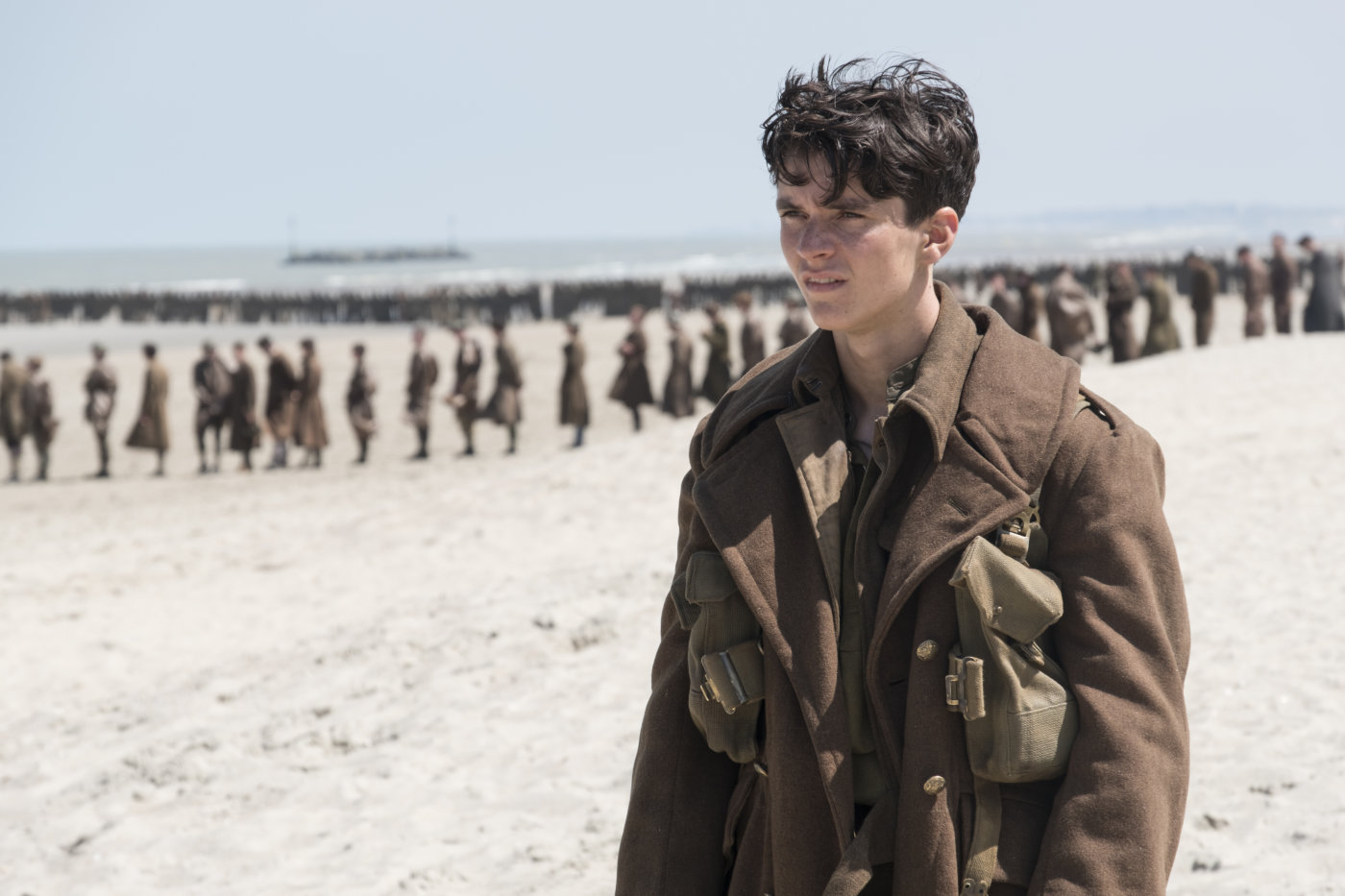
Not nearly as harrowing as the opening sequence of Steven Spielberg's Saving Private Ryan, Christopher Nolan's lean but unrelenting Dunkirk manages to remind us that war is indeed – as it always has been – hell.
With limited dialogue, immersive sound design, an at-times too insistent score (Hans Zimmer), and yes, impressive IMAX cinematography shot on 70mm (courtesy of Hoyte Van Hoytema), Nolan recreates the evacuation of British soldiers from the northern French seaport of Dunkirk as viscerally as possible (though blood and actual viscera are nowhere to be seen).
Unfolding in three overlapping time lines (which you will find either bold or gimmicky), Dunkirk is told from three points of view: a British soldier (Fionn Whitehead) trying to escape the precarious beach, with all manner of bad luck and German artillery befalling him; two Brit fighter pilots (Tom Hardy and Jack Lowden), charged with keeping their German counterparts at bay; and the crew of an English fishing trawler (captained by Mark Rylance), who answer the call to sail to France to rescue their boys.
It is the former timeline which is the most gripping, as young men (yes, including Harry Styles) struggle to stay alive until rescue arrives. Like Zimmer's score – and the Channel tide – the tension builds then subsides, only to be ratcheted up once more.
Indeed, Nolan's entire film is constructed as one big ticking clock, counting down not only until the rescue but that point where all three storylines converge. It's a device that keeps you close to the edge of your seat for the film's 106-minute running time (surprisingly short for Nolan), rendering the action effective if not necessarily affecting. Perhaps that is the point. Like Australia's own Gallipoli, which has generated an ugly nationalistic mythos, the story of the events Dunkirk is essentially one of failure and retreat: a turning point in the war, yes, but far from anything resembling victory.
Dunkirk is a Dutch word which translates as 'church in the dunes', but if there is a god, he had abandoned the British on that beach. The devil, however, is in the detail, and Nolan brings all of his cinematic prowess to bear on this tale which, while not celebrating war, honours British pluck and heroism. It's an impressive tribute.

In his fifth feature, and only his second for Hollywood, writer-director Edgar Wright attempts to re-imagine the 'car heist' genre by melding it with that of the musical (sort of).
And while by no means a car crash, the emphasis on automotive gymnastics and a pumping soundtrack in Baby Driver comes at the expense of human emotion. You might be awed by the technical display but you won't necessarily care for any of those people behind the wheel.
Principally that person is Baby (Ansel Elgort): a sunglasses-wearing, iPod-listening young man with very little to say but who sees and hears everything. He's the go-to getaway driver for crime boss, Doc (Kevin Spacey), who likes to mix up his crews for each heist but keeps Baby as a constant. Baby's a good luck charm, he's also in debt to Doc.
But when we meet him he's almost paid up - the old 'one last job' chestnut; Baby can see his way out of the life he has fallen into, and with romance blossoming between he and sweet diner waitress, Debora (Lily Rose), the future's looking bright. Of course life has a way of rear-ending you, and just when Baby thinks he's out -- and he and Debora might take to the open road with their super cool mixes blasting on the stereo -- he's pulled back in: forced to drive one more job for Doc.
Riding shotgun are Buddy (Jon Hamm) and Darling (Eiza Gonzalez), a sexed-up Bonnie and Clyde, and Bats (Jamie Foxx), a menacing, paranoid thug whose name is obviously a contraction of Bat Shit (as in crazy). And like the best laid plans in any heist movie, it all falls apart in spectacular fashion.
Rev heads will find much to delight in here, with Wright and his stunt car team producing impressive feats of precision driving which, unlike those in the Fast and Furious franchise, obey the laws of physics and logic (for the most part). There's also an insistent jukebox soundtrack to get your foot tapping and head nodding, but whether that qualifies Baby Driver as a musical remains debatable (I say no.).
What there isn't in Baby Driver is a care factor. Not on the director's part -- Wright deftly deploys his usual flare for quick cuts and quick wits -- but on the part of the audience. As sweet as Baby and Debora's romance is, and as noble as Baby's intentions are (ensuring the safety of his deaf foster father, Joseph (CJ Jones); trying to cause as little harm to bystanders as possible), it's hard to feel any sense of urgency for their safety. Will they make it out alive? Who cares? I didn't.
Baby Driver will thrill in the moment but it's the soundtrack, and not the characters, that will linger.

WAR FOR THE PLANET OF THE APES
20th Century Fox
July 27
No reviews as yet but the early word from media screenings for this third installment of the Apes reboot is pretty darn good. With the Rise of the Planet of the Apes in 2011, and then Dawn of the Planet of the Apes in 2014, Fox showed they were capable of creating blockbusters with smarts. They also proved that motion-capture performances can be truly amazing. Seriously, how good is Andy Serkis as Caesar? Will this be the film that -- finally -- lands him an Oscar nomination? Matt Reeves is again at the helm as the apes and humans are once again headed for war.
ALI'S WEDDING
Madman Films
August 31
Winning the Audience Award at the recent Sydney Film Festival, this Australian comedy looks set to be the local breakout hit of the year. Co-written by actor, writer and comedian Osamah Sami (with Andrew Knight; Hacksaw Ridge, The Water Diviner), it is based on a true story from Sami’s life. After a reckless lie sets off a catastrophic chain of events, Ali (Sami), the son of a Muslim cleric, finds himself caught between his sense of duty to his family and following his heart. The film also stars Don Hany, Ryan Corr and newcomer Helana Sawires, who plays the Australian-born Muslim Osamah would prefer to marry and not the arranged bride of his parents' choosing. My Big Fat Muslim Wedding? Sounds like an invitation too good to pass up.
BATTLE OF THE SEXES
20th Century Fox
September 28
There are as many good films about tennis as Anna Kournikova has singles titles, so while Jonathan Dayton and Valerie Faris (the creative team behind Oscar-winning Little Miss Sunshine) have a low net to clear, my hopes for Battle of the Sexes to be aces are pretty high. Emma Stone plays Billie Jean King and Steve Carell is Bobby Riggs, two American tennis greats and opposite ends of their careers in 1973, and opposite sides of the fight for sexual equality, when they decided to go head-to-head on the tennis court. From the trailer, the film certainly gets the 1970s look right, and, promisingly, it will also touch on King's sexuality. (I'm also hoping the film shows Riggs' first man v woman match; where he kicked the ass of one-time Australian tennis great, now loudmouth bigot, Margaret Court.)
PADDINGTON 2
StudioCanal
December 21
One of the delights of recent years was the first big screen outing for the much-loved book and TV show Paddington; the Peruvian bear with a penchant for marmalade and a knack for getting into trouble in his adopted London home. Perfectly voiced by Ben Whishaw, and supported by humans Sally Hawkins, Hugh Bonneville and Julie Walters, Paddington 2 again sees the bear in the sights of a not-so nice Londoner; Hugh Grant taking up the evil mantle left by Nicole Kidman in the first film. It will be interesting to see if the Brexit vote has impacted the world of Paddington -- the first film was very much about an immigrant finding a new, welcoming home in London -- but if it has the same warmth, charm and British sense of humour as the first, then Paddington 2 should be a treat.
CALL ME BY YOUR NAME
Sony Pictures
December 26
I haven't read the novel by Andre Aciman, but the glowing reviews following the Sundance premiere of Luca Guadagnino's adaptation (penned by James Ivory) of this gay coming of age tale -- as well as the overwhelmingly positive response from its Sydney Film Festival showing (jealous!) -- has made Call Me By Your Name my most anticipated film for the remainder of 2017. There's already awards buzz for this sun-drenched tale set in early 1980s Italy, where the teenage son of a professor falls for his father's intern (Armie Hammer). Timothee Chalamet, Michael Stuhlbarg and Hammer, seemingly gifted his best role since 2010's The Social Network, have all been praised for their performances. Now if someone could just make my dream project -- Armie Hammer as American tennis legend Bill Tillden -- that'd be great.

It's 1979, and in a post-Vietnam, post-'summer of love', feminist-era Santa Barbara, Dorothea Fields (Annette Bening) is coming to terms with a brave new world.
The single mother is also coming to terms with an adolescent son, Jamie (Lucas Jade Zumann), on the cusp of manhood and what exactly that means for the both of them. How does she raise him to be a good man? And how does he assert his independence away from her?
The former question sees Dorothea enlist Abbie (Greta Gerwig), her arty tenant, and Julie (Elle Fanning), a neighbour and slightly older friend and confidant of Jamie, in her cause. For Jamie, it means testing the waters and pushing the boundaries; breaking curfew, and occasionally Dorothea's heart, in a bid to see just what he can get away with whilst determining what kind of man he wants to be.
Written and directed by Mike Mills (Beginners, 2011), 20th Century Women celebrates the roles that women play in shaping the men we become, and more specifically, the mothers who sacrifice so much to give their children the best possible tools for making a positive mark on the world.
The performances (including Billy Crudup as a New Age handyman lodger) are uniformly good, with Bening and Gerwig the standouts.
It may not pack the emotional punch of Beginners – Mills' autobiographical tale of his father's late-in-life coming out and simultaneous battle with cancer, though it does boast some of the same stylistic flourishes – but 20th Century Women is affecting nonetheless.

About 14-months ago, I wrote about how awful Batman V Superman: Dawn of Justice was. The second of Zack Snyder's DC Extended Universe films, after the disappointing Man of Steel (2014), BVS was a dimly-lit, over-long mess of a film with one saving grace: Wonder Woman.
But did Wonder Woman look impressive simply by virtue of being surrounded by shit? And how would Gal Gadot's Amazonian princess fare when forced to carry the weight of her own film on her muscular shoulders?
The good news: Wonder Woman is not terrible. In fact, it's quite good. And in terms of DCEU films, it's arguably the best so far. A low bar to hurdle, to be sure, but the film, director Patty Jenkins (2003's Monster), and Gadot do so with all the determined grace you'd expect of a warrior princess.
Jenkins, and screenwriter Allen Heinberg, have obviously used Captain America: The First Avenger (still one of Marvel's best efforts) as both inspiration and their template; its world war setting, unconsummated romance, and an at-first naive hero who fights for what they believe is right and not simply for what is ordered of them are all from that other film's playbook. (Even one character's sacrifice at the end of Wonder Woman is either an homage to, or a blatant rip-off of The First Avenger's final moments.)
But Wonder Woman is its own film, too. From Themyscrica, the secret island home of the Amazons ruled by Queen Hippolyta (Connie Nielsen) -- and where her daughter, Diana (WW's actual name), is trained for combat by her aunt, General Antiope (a fierce Robin Wright) -- to the muddy trenches of No Man's Land and the battlefields of World War I, Jenkins creates two very distinct but wholly believable worlds.
Those worlds collide when Steve Trevor (Chris Pine) crashes his plane off the Themyscrican coast and is rescued by Diana, who is given an immediate introduction to the dangers that mankind presents when German soldiers storm the beach. It's 1918 and Trevor, a US spy who, having gone undercover behind enemy lines, has escaped from the Germans with the notebook of so-called Dr Poison (Elena Anaya). She has been developing a biochemical weapon to win the war and help General Erich Ludendorff (Danny Huston) prevent the signing of the Armistice.
Tales of this great war, and the possibility that it is Ares, the god of war and sworn enemy of the Amazons, orchestrating it, ignites Diana's sense of justice and piques her adventurous spirit; accompanying Trevor back to London ("It's hideous!") and then on to the Front, where Diana witnesses firsthand man's cruelty towards his fellow man. It's also the film's best set piece: Wonder Woman rising from the trenches, going over the top and single-handedly taking down a German battalion. She then liberates a nearby village with equally impressive force.
But in spite of the superhuman heroics, in Wonder Woman we have an identifiable heroine. She may be a warrior princess and daughter of a god, but Diana also has a child-like wonder; a curious nature that has her thirsting for knowledge. She also has a very strong sense of what is right and what is wrong. And she's still learning. As much as Jenkins' film is a big screen coming out for Wonder Woman, it's also Diana's coming of age tale.
Unfortunately Jenkins can't avoid the third act curse of the superhero film: a GCI-heavy, low stakes showdown between heroine and villain. (Spoiler alert: Wonder Woman doesn't die.) But in spite of this bloat and wobble, Wonder Woman manages to stick the landing. And we won't have to wait an eternity to see her again: Diana will be back, alongside her fellow superheroes, in Justice League later this year.
Here's hoping we don't have to wait too long to see her front and centre of her own film again, now that we know Gadot and Jenkins are both well and truly up to the task.

The most discomfiting Australian film since 2011's Snowtown, Hounds of Love doesn't achieve Justin Kurzel's level of excruciating brilliance but Ben Young's directorial debut is, for the most part, an excellent foray into the domestic horror genre.
Not based on actual events like Kurzel's debut, Hounds of Love is set during a sweltering December in the lead up to Christmas. It's 1987 and a simpler time in Australia, so much so that when teenage girls go missing with seeming regularity, police brush their parents off with assurances that they've simply run away. No one would suspect their sleepy little 'burb to be the hunting ground of a sex predator or, worse still, a serial killer. Make that two.
For John White (Stephen Curry, perfectly creepy) is ably assisted in his abduction, rape, torture and murder of these young women by Evie (Emma Booth), who shares John's passion for cruel sexual thrills. Or does she? Is Evie also a victim? Certainly of domestic abuse, both physical and psychological, but she's very much an accomplice. Her presence in John's car as he cruises for his prey is the honey in the trap: he can't possibly be a bad guy if he has a woman with him, right?
The opening scenes of Hounds reveals John and Evie's modus operandi, from pick up to disposal, so we know what's in store for Vicky (Ashleigh Cummings) when, after climbing out her bedroom window to attend a party after being grounded by her mother (Susie Porter), she's picked up by the predators with the promise of cheap pot, and then cheaper wine, back at their place.
Cue (not completely unwarranted) accusations of torture porn as we spend the next 36 or so hours inside an unassuming brick house on Malcolm Street as a series of humiliations and horrors unfold for Vicky, and also Evie. As Vicky takes every opportunity to escape -- from an encoded runaway letter forged at knife point, to attempting to get inside Evie's head -- Evie slowly becomes unhinged; suspecting that John may be taking more of an interest in their latest capture than he usually does.
For the first hour of Hounds of Love, the tension is palpable as we bear witness to two monsters at play and watch, helplessly, as their victim suffers at their hands (and the sex toys contained in a brown shoe box). It's a controlled study in the banality of evil.
But then Young seems to remember his film is also a thriller and, whether to hit certain beats or draw out the tension, his film begins to lose momentum. Young even gives a nod to Silence of the Lambs in the film's climactic moments, which are tense but also a little too drawn out. In its best moments, however, Hounds of Love is truly horrifying.

The Zookeeper's Wife, directed Niki Caro (Whale Rider, 2002), is adapted from the 2007 Diane Ackerman novel by Angela Workman, and it is very much a workman-like effort. Solid and tasteful (and handsomely mounted for just $20 million) it's not the least bit remarkable: the film trades on cute animals and the horrors of the Holocaust to wring tears from the audience.
Jessica Chastain, who is also a producer on the film, is valiant in spite of her distractingly thick Polish accent. She plays Antonina Zabinski, the wife of the keeper at Warsaw Zoo, Jan Zabinski (Johan Heldenbergh), who together, when war arrives, decide to use their bombed out animal park to house, hide and aid in the escape of Jews from the Warsaw ghetto.
Although based on actual events – and end credit tells us that the Zabinskis saved some 300 lives, men, women and children – the film is more storybook than history book. That's not helped by Daniel Bruhl as Lutz Heck, a snarling Nazi villain and fellow zoologist with an eye for Antonina. (Ironically, among a cast who speak English with varying Polish accents, German actor Bruhl sounds the most English.)
You may get weepy during The Zookeeper's Wife but Caro's film boasts very few real emotions and only the occasional dose of suspense. Perhaps Ackerman's novel would be a better place to learn about the heroics of the Zabinskis; good people who risked their own lives to save others from a once unimaginable horror which is, sadly, all too believable today.