
Love isn't perfect. And it never will be, no matter how much you plan or how hard you try. And try. And try. And try. It's a lesson that's learnt too late by the protagonist of The Infinite Man, writer-director Hugh Sullivan's trippy, time travel debut feature.
Having planned the perfect anniversary away with his girlfriend right down to the last detail, Dean (John McConville) finds his well laid plans immediately thrown out the window: the motel he and Lana (Hannah Marshall) stayed at the previous year -- close to the beach but seemingly in the middle of nowhere -- is no longer in business.
And not before long, Hannah's ex, Terry (Alex Dimitriades), an ex-Olympic javelin thrower with questionable Greek heritage and an even more questionable grasp on reality, gatecrashes their getaway determined to win Hannah back. And somehow he succeeds? Worst. Anniversary. Ever.
But rather than grieve and move on, Dean refuses to leave the past behind: he's determined to revisit it - and fix it. Somehow Dean fashions a sort of time machine (Sullivan isn't big on explanations) and on the anniversary of that previous anniversary, he invites Hannah back to the rundown motel so they can travel back one year and right the wrongs. What could possibly go wrong?
As multiple Deans and Lanas -- and a Terry or two -- begin to arrive in the middle of nowhere, things become further complicated. Previous events and conversations are viewed from entirely different angles yet even with the advantage of hindsight (or is it foresight?), Dean still can't manage to have events go in his favour. Time is either linear or circular depending on your school of thought, but the human heart is unpredictable and human error almost always inevitable.
The second Australian film this year to play with time travel (after the recent mind-bender, Predestination), The Infinite Man does so more inventively and far more comically. But while the film will invite comparisons to both Groundhog Day and Eternal Sunshine of the Spotless Mind, it has neither the laughs of the former nor the emotional resonance of the latter.
Still all three performances in The Infinite Man are good, particularly McConville's, even if one finds it hard to root for a hero who is such a loser (and a tad creepy). Nor does Marshall's Lana give any real indication as to why two men would be so obsessed with her. But the heart wants what it wants, even if Hugh Sullivan's film is very much an intellectual rather than emotional exercise.

Richard Linklater would appear to be a filmmaker preoccupied with time. In his Before trilogy, he followed a couple -- Celine (Julie Delpy) and Jesse (Ethan Hawke) -- over the course of 20 years; revisiting them every nine years to see where they've been, where they are, and where they're headed.
That series culminated in 2013's Before Midnight -- and a tour de force performance by Delpy -- and was an extremely satisfying filmic journey and arguably one of the best trilogies in cinema.
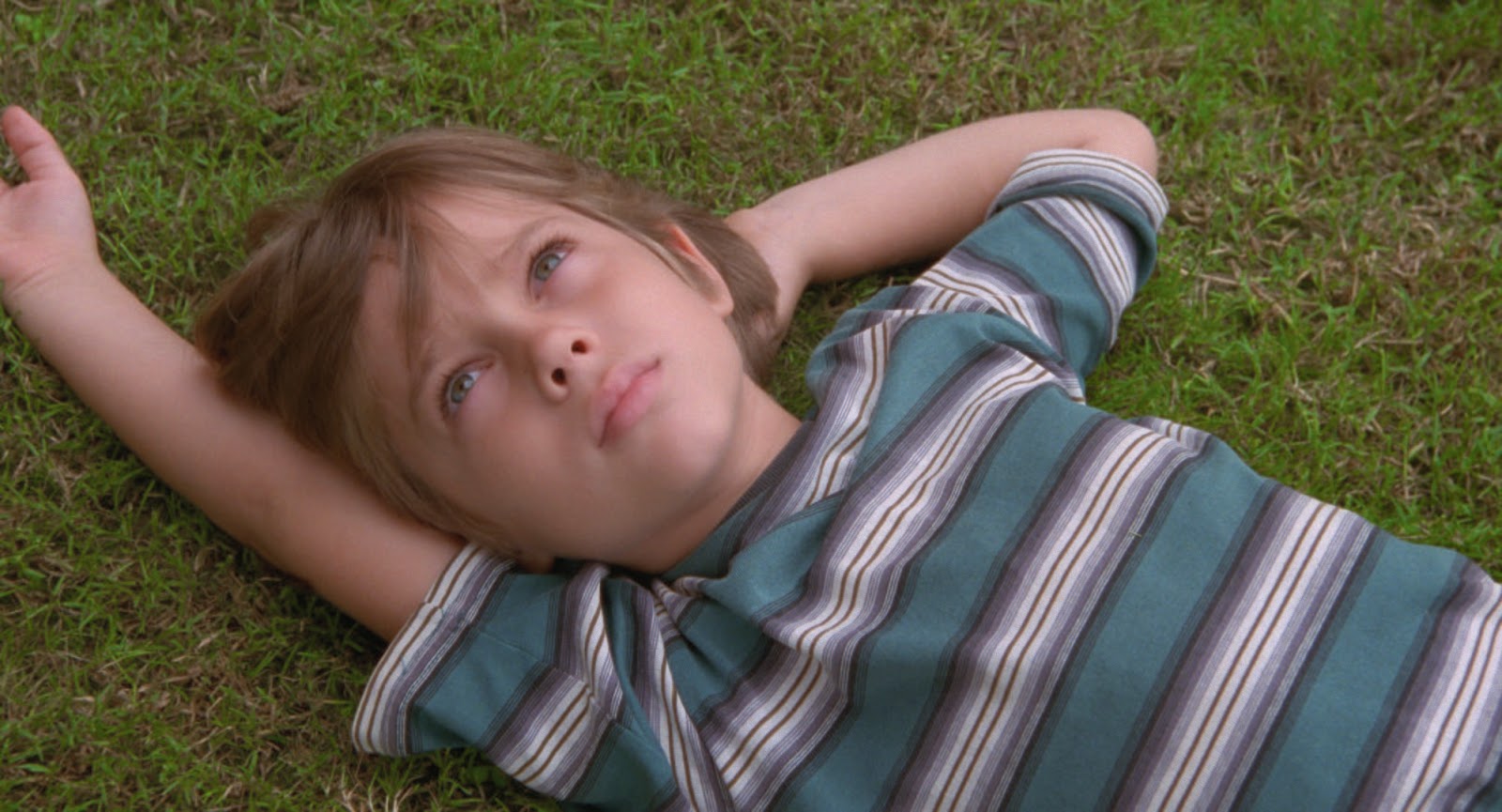
And now in an even bolder cinema experiment, writer-director Linklater has set out to capture a life on film: following young Mason (Ellar Coltrane) from age six to 18, from boyhood to his first day of college. The ambitious conceit being that Mason isn't played by three different actors, as would happen in a typical coming of age film, but the one kid; captured on film every year for 12 years: Linklater and his cast gathering for a few days (39 in total) a year, every year over the time period.
Mason (and Coltrane, who has just turned 20) literally grows up before our eyes. There are no title cards to tell us what year it is (the film begins in 2000) or how old Mason is, but the ebb and flow of time is evident in the changing haircuts, his increasing height and his thinning out as Mason sheds his puppy fat and grows into a slim, long-limbed adolescent.
But it's not just Mason's journey we follow. His mother, Olivia (Patricia Arquette), who raises him and his older sister, Samantha (Lorelei Linklater, the director's daughter), is integral to the story, not just as the primary caregiver (she's separated from their dad, Mason Snr., Ethan Hawke) but as a woman trying to better herself (returning to college) and in turn provide a better life for her kids.
That involves some less than perfect marriages, for even someone studying, and eventually teaching psychology can repeat the same mistakes, over and over. But to err is human, and Boyhood is as much a coming of age story as it is a testament to single motherhood.
Essentially about nothing and everything, the magic of Linklater's experiment is just how much we are invested in these peoples' lives. Not just Mason's but his mum's (Arquette is the film's MVP), his dad's (Hawke, effortlessly impressive), sister and friends. People come and go as Mason and his family move homes, towns, and eventually away from each other.
That's life, and its milestones, big and small, are captured in all their banality without any fanfare or concocted melodrama. It may not require its 165-minute run time but your patience will be rewarded: you won't begrudge a second spent in the company of this family and in this boy's life.
.jpg)
Woody Allen makes a film every year. Every year. And without meaning to sound patronising, that's impressive for a 78-year-old. But there's a difference between keeping busy and producing good (or great) work, and the results are often evident in the New York auteur's post-2000 oeuvre.
For for every good film (Match Point (2005), Vicky Cristina Barcelona (2008), Midnight In Paris (2011), Blue Jasmine (2013)), Allen seems to follow-up with a less than stellar effort: Scoop (2006), and To Rome With Love (2012), for example. And so it is with Magic In The Moonlight, which, even if it didn't come so soon after the award-winning Blue Jasmine (and Cate Blanchett's towering tragi-comic performance) would suffer from unmet audience expectations.
For on paper, Magic in the Moonlight has the right ingredients to succeed, or at the very least entertain: two fine actors in the leads (Colin Firth and Emma Stone), a playful battle of wits between cynicism and open-mindedness, and period detail and picturesque locales in the south of France.
It's 1928, and professional magician Stanley Crawford (Firth), who works under the stage name (and yellow face) of Wei Ling Soo, is called upon by an old colleague, Howard Burkan (Simon McBurney), to travel to the Cote d'Azur where he believes a young American spiritualist is trying to swindle a visiting wealthy family. Stanley agrees, for if there is nothing he enjoys more than wowing an audience with his teleportation tricks -- elephants and himself -- it's debunking those who profess to claim actual powers of the occult.
Firth (the least Allen-esque avatar for some time) seems to be channeling his infamous Mr Darcy role, sans brooding silence. Stanley is never short of a word or two, and he's full of pride and extremely prejudiced. But his claws retract somewhat when he meets Sophie Baker (Emma Stone), the big-eyed, red-haired American who claims to be in contact with the spirit world. And like Elizabeth Bennett, Sophie takes great delight in confounding her scowling opposite.
The age difference aside, there's not much chemistry to speak of between Firth and Stone: Stanley's dialogue seems to consist of Allen bits on the meaningless of life, and when he's not sharing them with everyone he's letting everyone know how intellectually superior he is to them. As for Stone, ostensibly an ideal actress for a Woody Allen film, she looks great in period dress but her comic ability is under-utilized. Maybe it's the summer sun in the south of France, but there's a lack of energy to their interplay and the film in general.
Marcia Gay Harden, as Sophie's mother, and Jacki Weaver, as the wealthy widow in Sophie's sites (she plans to fund the young clairvoyant's research facility), aren't given a whole lot to do either, which is odd given that you can almost always rely on Woody to write great roles for women. But thankfully there's Eileen Atkins as Stanley's Aunt Vanessa, the only person whose opinion he values and who is not afraid to challenge his 'logical' ways.
Perhaps this late 1920s tale comes too soon in the wake of Midnight In Paris, where Allen's protag and avatar (played by Owen Wilson) found a way to travel back through time to Paris in the 1920s and hob-knob with his literary and artistic heroes. Indeed, at one Gatsby-esque party scene in Magic in the Moonlight, one can't help but hope for Marion Cotillard's muse from 'Midnight' to wander in off the lawn and lead us off to another more fascinating soiree.
Alas, that's not to be and ultimately Magic in the Moonlight fades not too long after the end credits roll. This is not a summer -- nor a Woody Allen film -- to remember. But we'll always we have Midnight in Paris.

Predestination may begin simply enough -- a man walks into a bar -- but by the end of this taut little tale of time travel, you'll feel as though you've spent the evening in said bar, knocking back one too many stiff drinks. For to paraphrase the most famous of time travelers, the titular Doctor of long-running sci-fi TV series Doctor Who, Predestination is "wibbly-wobbly, timey-wimey"; a mind-bending, head-scratcher of a film.
The aforementioned man is a newspaper advice columnist, whose pen name is The Unmarried Mother, and he believes he has a story worthy of winning a free bottle of whisky from the bartender (Ethan Hawke). As the night unfolds, the writer tells his incredulous story which begins in an orphanage, proceeds to a cadetship with the space program, and eventually leads to his current employment.
His story also begins with him as a female. And as played by Sarah Snook (looking a little like Leo DiCaprio; a little like Dane DeHaan), that tale is never less than riveting and empathetic. It is also linked to that of the Fizzle Bomber, a domestic terrorist who has been terrorizing the city.
The bomber is also the number one target of the bartender who happens to be a Temporal Agent i.e. time travelling cop, who has been in pursuit of the Fizzle Bomber for years. That the writer walked into this bar on this night is no accident either. That's about as much plot detail for Predestination as one can give before moving into spoiler territory. It's a riddle, wrapped in an enigma and paradoxical would be putting it mildly.
Adapted from a short story (All You Zombies by Robert A. Heinlein) by the Spierig Brothers, Michael and Peter (2009's Daybreakers), it's not unlike something the Wachowskis would enjoy sinking their teeth into; Predestination playing with theories of time and gender, and defying audience expectations to dizzying if not entirely logical effect. For be warned: your head will hurt by the time the end credits roll.
That's by no means a bad thing. Too few films today require a mental workout from its audience, and even if you guess at how the writer, the bartender and the bomber are linked, you're still likely to develop a migraine doing the 'chicken or the egg' calculations.


.jpg)
